
Someone said that there is a way better top these days. What is it?
Brian

On Thu, 14 Nov 2024, Brian E. Lavender wrote:
Someone said that there is a way better top these days. What is it?
bottom(btm). gives you super fun graphs and stuff:
https://github.com/ClementTsang/bottom
see attached screencap which is from my firewall. Also, I am using st (with a theme) as my terminal emulator: https://st.suckless.org/
sen-h.
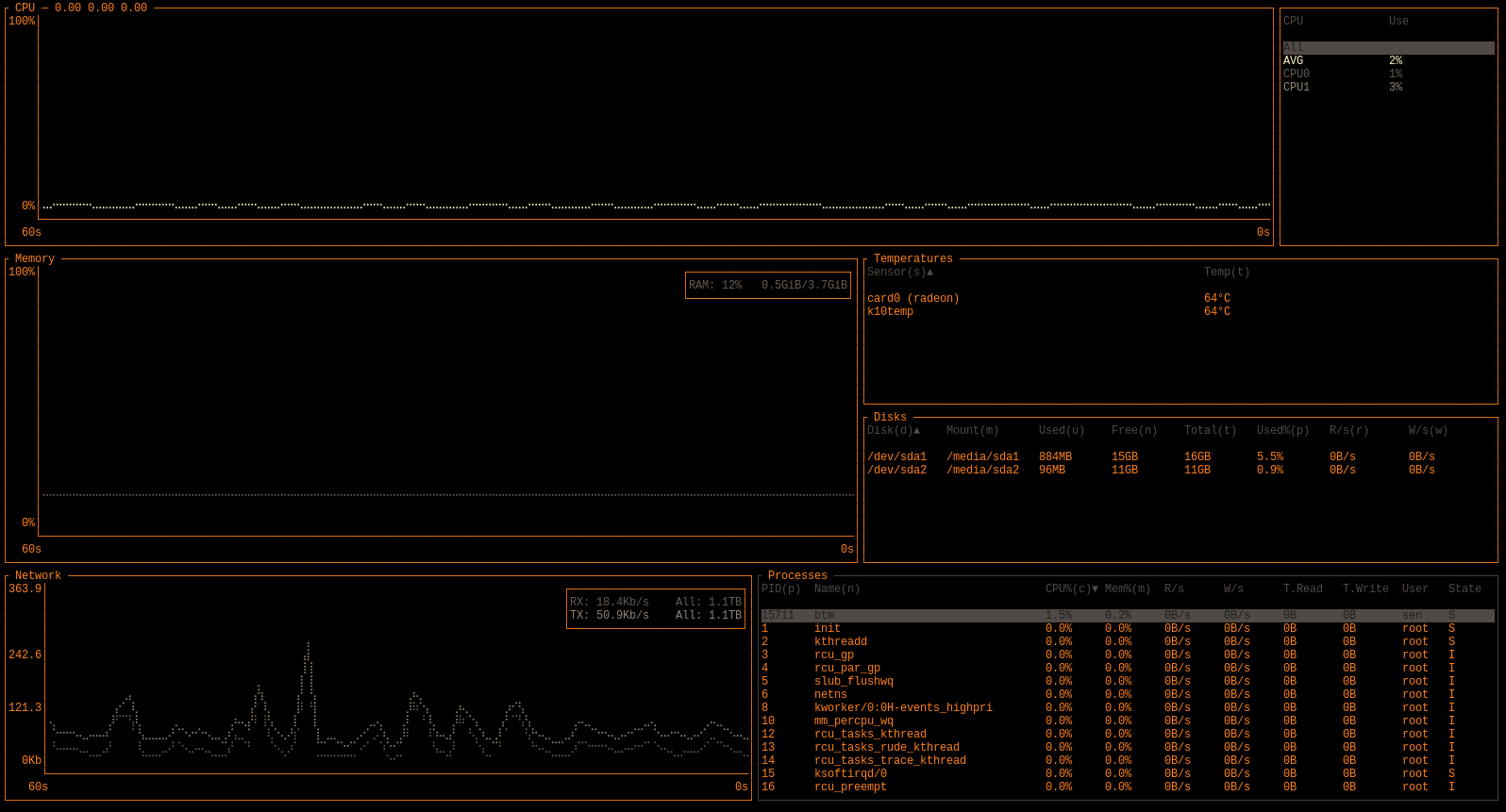
Hmm, I guess bottom isn't packaged into Fedora. I just tried htop. It at least shows the load on all 20 cores. The screen shots for bottom look very nice!
Brian
On Thu, Nov 14, 2024 at 01:20:03PM -0800, Sen Hastings wrote:
On Thu, 14 Nov 2024, Brian E. Lavender wrote:
Someone said that there is a way better top these days. What is it?
bottom(btm). gives you super fun graphs and stuff:
https://github.com/ClementTsang/bottom
see attached screencap which is from my firewall. Also, I am using st (with a theme) as my terminal emulator: https://st.suckless.org/
sen-h.
Lug-nuts mailing list -- lug-nuts@bigbrie.com To unsubscribe send an email to lug-nuts-leave@bigbrie.com

There are a lot of graphy top alternatives out there lately. Bashtop has been my favorite as of late.
On Thu, Nov 14, 2024 at 2:39 PM Brian E. Lavender brian@brie.com wrote:
Hmm, I guess bottom isn't packaged into Fedora. I just tried htop. It at least shows the load on all 20 cores. The screen shots for bottom look very nice!
Brian
On Thu, Nov 14, 2024 at 01:20:03PM -0800, Sen Hastings wrote:
On Thu, 14 Nov 2024, Brian E. Lavender wrote:
Someone said that there is a way better top these days. What is it?
bottom(btm). gives you super fun graphs and stuff:
https://github.com/ClementTsang/bottom
see attached screencap which is from my firewall. Also, I am using st
(with
a theme) as my terminal emulator: https://st.suckless.org/
sen-h.
Lug-nuts mailing list -- lug-nuts@bigbrie.com To unsubscribe send an email to lug-nuts-leave@bigbrie.com
-- Brian Lavender https://www.brie.com/brian/
"There are two ways of constructing a software design. One way is to make it so simple that there are obviously no deficiencies. And the other way is to make it so complicated that there are no obvious deficiencies."
Professor C. A. R. Hoare The 1980 Turing award lecture _______________________________________________ Lug-nuts mailing list -- lug-nuts@bigbrie.com To unsubscribe send an email to lug-nuts-leave@bigbrie.com

I'll typically use atop or htop but if they aren't available top itself will work and I just give it a '1' to get the multicore view.
On Thu, Nov 14, 2024, 2:39 PM Brian E. Lavender brian@brie.com wrote:
Hmm, I guess bottom isn't packaged into Fedora. I just tried htop. It at least shows the load on all 20 cores. The screen shots for bottom look very nice!
Brian
On Thu, Nov 14, 2024 at 01:20:03PM -0800, Sen Hastings wrote:
On Thu, 14 Nov 2024, Brian E. Lavender wrote:
Someone said that there is a way better top these days. What is it?
bottom(btm). gives you super fun graphs and stuff:
https://github.com/ClementTsang/bottom
see attached screencap which is from my firewall. Also, I am using st
(with
a theme) as my terminal emulator: https://st.suckless.org/
sen-h.
Lug-nuts mailing list -- lug-nuts@bigbrie.com To unsubscribe send an email to lug-nuts-leave@bigbrie.com
-- Brian Lavender https://www.brie.com/brian/
"There are two ways of constructing a software design. One way is to make it so simple that there are obviously no deficiencies. And the other way is to make it so complicated that there are no obvious deficiencies."
Professor C. A. R. Hoare The 1980 Turing award lecture _______________________________________________ Lug-nuts mailing list -- lug-nuts@bigbrie.com To unsubscribe send an email to lug-nuts-leave@bigbrie.com
The '1' works awesome!
👍
And, I got my emojis working in Fedora!
On Thu, Nov 14, 2024 at 05:46:11PM -0800, Aria wrote:
I'll typically use atop or htop but if they aren't available top itself will work and I just give it a '1' to get the multicore view.
On Thu, Nov 14, 2024, 2:39 PM Brian E. Lavender <[1]brian@brie.com> wrote:
 Hmm, I guess bottom isn't packaged into Fedora. I just tried htop.
 It at
 least shows the load on all 20 cores. The screen shots for bottom
 look
 very nice!
 Brian
 On Thu, Nov 14, 2024 at 01:20:03PM -0800, Sen Hastings wrote:
 >
 >
 > On Thu, 14 Nov 2024, Brian E. Lavender wrote:
 >
 > > Someone said that there is a way better top these days. What is
 it?
 >
 > bottom(btm). gives you super fun graphs and stuff:
 >
 > [2]https://github.com/ClementTsang/bottom
 >
 > see attached screencap which is from my firewall. Also, I am using
 st (with
 > a theme) as my terminal emulator: [3]https://st.suckless.org/
 >
 > sen-h.
 > _______________________________________________
 > Lug-nuts mailing list -- [4]lug-nuts@bigbrie.com
 > To unsubscribe send an email to [5]lug-nuts-leave@bigbrie.com
 --
 Brian Lavender
 [6]https://www.brie.com/brian/
 "There are two ways of constructing a software design. One way is to
 make it so simple that there are obviously no deficiencies. And the
 other
 way is to make it so complicated that there are no obvious
 deficiencies."
 Professor C. A. R. Hoare
 The 1980 Turing award lecture
 _______________________________________________
 Lug-nuts mailing list -- [7]lug-nuts@bigbrie.com
 To unsubscribe send an email to [8]lug-nuts-leave@bigbrie.com
References
- mailto:brian@brie.com
- https://github.com/ClementTsang/bottom
- https://st.suckless.org/
- mailto:lug-nuts@bigbrie.com
- mailto:lug-nuts-leave@bigbrie.com
- https://www.brie.com/brian/
- mailto:lug-nuts@bigbrie.com
- mailto:lug-nuts-leave@bigbrie.com
Lug-nuts mailing list -- lug-nuts@bigbrie.com To unsubscribe send an email to lug-nuts-leave@bigbrie.com

It turs out, there are a lot of tops out there. I thought I might find pw-top usefule. I found these 3 that might fit the bill for you. I had heard of the first two before. It all depends on how you define "better". I find top pretty much does what I need, mnost of the time.
Maybe atop:
An advanced interactive monitor for Linux-systems to view the load on system-level and process-level. The command atop has some major advantages compared to other performance-monitors: - Resource consumption by all processes - Utilization of all relevant resources - Permanent logging of resource utilization - Highlight critical resources - Watch activity only - Watch deviations only - Accumulated process activity per user - Accumulated process activity per program
or btop:
Modern and colorful command line resource monitor that shows usage and stats https://github.com/aristocratos/btop Apache-2.0 and MIT and Public Domain Resource monitor that shows usage and stats for processor, memory, disks, network and processes.
C++ version and continuation of bashtop and bpytop.
or maybe bpytop:
Resource monitor that shows usage and stats for processor, memory, disks, network and processes.
Python port and continuation of bashtop.
Features
* Easy to use, with a game inspired menu system. * Full mouse support, all buttons with a highlighted key is clickable and mouse scroll works in process list and menu boxes. * Fast and responsive UI with UP, DOWN keys process selection. * Function for showing detailed stats for selected process. * Ability to filter processes, multiple filters can be entered. * Easy switching between sorting options. * Send SIGTERM, SIGKILL, SIGINT to selected process. * UI menu for changing all config file options. * Auto scaling graph for network usage. * Shows message in menu if new version is available * Shows current read and write speeds for disks
-Gary
On Thu, Nov 14, 2024 at 12:45:05PM -0800, Brian E. Lavender wrote:
Someone said that there is a way better top these days. What is it?
Brian
Brian Lavender https://www.brie.com/brian/
"There are two ways of constructing a software design. One way is to make it so simple that there are obviously no deficiencies. And the other way is to make it so complicated that there are no obvious deficiencies."
Professor C. A. R. Hoare The 1980 Turing award lecture _______________________________________________ Lug-nuts mailing list -- lug-nuts@bigbrie.com To unsubscribe send an email to lug-nuts-leave@bigbrie.com
I have this old computer, probably from 2015, I see the CPU was released in 2011. The mouse is acting up, and every few months, like 9 or 10, it crashes or reboots or something like that. I always investigate. It happened today (yes, I'm going to replace it. It's my unenclosed system and I have stuff hanging off itLOL. But it is probably time).
I noticed some entries about loading and unloading BPF. At first, I read the Wikipedia article. I wish Jimmy would stop asking for money and just cavort with his "executive staff." But the section on security was interesting.
Has anybody played with BPF?
On this particular system, when it tries to load or unload the BPF, it gets a permission denied. For as far back as I have logs and it does this a few times a day. Usually about a second apart. For the entries around the crash, it tried to do this multiple times over the course of about 7 seconds. The system rebooted when it crashed BTW.
In looking at another system, there are no permission denied errors. This sequence, load BPF then unload BPF about a second later, seems to run every day, just after midnight, right around logrotate. For as far back as I have logs, it runs just after midnight and at one other seemingly random time of day.
Given what BPF does, this is kind of suspicious. But since it has been going on for awhile, I'm not going to do anything rash.
It seems to be only in the logs for actual CPU, as opposed to VM's.
Another curious fact is that the system that crashed and generates the permission denied errors has an AMD processor and the other systems I have are Intel.
I plan to continue investigating, but I thought I would see if anyone had any thoughts that might prevent me from wasting a lot of time.
-Gary

On 11/21/24 09:32, Gary wrote: [elided]
Hi Gary,
You forget to mention which O.S., when it was last updated, kernel version, and you didn't list any actual log messages. It's hard to do much with general hand-wavy remarks.
I'm sure I've done worse, but we can all do better. ;-)
Best regards,
OK. I'll give it a shot.
Linux version 5.17.5-300.fc36.x86_64 (mockbuild@bkernel01.iad2.fedoraproject.org) (gcc (GCC) 12.0.1 20220413 (Red Hat 12.0.1-0), GNU ld version 2.37-24.fc36) #1 SMP PREEMPT Thu Apr 28 15:51:30 UTC 2022
Based on your request, I started looking around for something to send you. After a lot of scrolling around, I found this in the log:
2024-11-21T07:37:07.740484-08:00 Bastion audit[2514]: CRED_DISP pid=2514 uid=100 0 auid=1000 ses=24 subj=unconfined_u:unconfined_r:unconfined_t:s0-s0:c0.c1023 ms g='op=PAM:setcred grantors=pam_unix acct="root" exe="/usr/bin/su" hostname=? add r=? terminal=/dev/pts/0 res=success' 2024-11-21T07:37:07.740855-08:00 Bastion audit[1717]: USER_LOGOUT pid=1717 uid=0 auid=1000 ses=24 subj=system_u:system_r:xdm_t:s0-s0:c0.c1023 msg='op=logout id=1000 exe="/usr/sbin/lightdm" hostname=Bastion.mcg addr=? terminal=/dev/tty1 res=success' 2024-11-21T07:37:07.740970-08:00 Bastion ModemManager[645]: <info> caught signal, shutting down... 2024-11-21T07:37:07.741529-08:00 Bastion systemd[1]: Stopping session-24.scope - Session 24 of User gmcglinn... 2024-11-21T07:37:07.747574-08:00 Bastion audit[1717]: USER_END pid=1717 uid=0 auid=1000 ses=24 subj=system_u:system_r:xdm_t:s0-s0:c0.c1023 msg='op=PAM:session_close grantors=pam_selinux,pam_loginuid,pam_selinux,pam_keyinit,pam_namespace,pam_keyinit,pam_limits,pam_systemd,pam_unix,pam_gnome_keyring,pam_lastlog,pam_umask,pam_lastlog acct="gmcglinn" exe="/usr/sbin/lightdm" hostname=? addr=? terminal=:0 res=success'
Which has nothing to do with BPF. Since my original post, I have found instances in the log where BPF runs just fine. It looks like the shutdown occurred about 40 min before I noticed, and the interesting repeating BPF entries occur about 40 min after the shutdown.
I'm a bit confused. The system had the monitor turned off and I was ssh'd into it from another system. It shouldn't have shutdown without me issuing an explicit shutdown request of some kind. But, it's old, and so it is probably just crufty.
But, since I was focused on BPF initially, I took a look at the logs for the system I was on (the remote system) and that's when I saw the interesting log entries:
Nov 18 00:00:01 entertain audit: BPF prog-id=470 op=LOAD Nov 18 00:00:01 entertain audit: BPF prog-id=470 op=UNLOADNov 18 00:00:01 entertain systemd[1]: Starting logrotate.service - Rotate log fi les... Nov 18 00:00:01 entertain systemd[1]: unbound-anchor.service: Deactivated succes sfully. Nov 18 00:00:01 entertain systemd[1]: Finished unbound-anchor.service - update o f the root trust anchor for DNSSEC validation in unbound. Nov 18 00:00:01 entertain audit[1]: SERVICE_START pid=1 uid=0 auid=4294967295 se s=4294967295 subj=system_u:system_r:init_t:s0 msg='unit=unbound-anchor comm="sys temd" exe="/usr/lib/systemd/systemd" hostname=? addr=? terminal=? res=success' Nov 18 00:00:01 entertain audit[1]: SERVICE_STOP pid=1 uid=0 auid=4294967295 ses =4294967295 subj=system_u:system_r:init_t:s0 msg='unit=unbound-anchor comm="syst emd" exe="/usr/lib/systemd/systemd" hostname=? addr=? terminal=? res=success' Nov 18 00:00:01 entertain systemd[1]: logrotate.service: Deactivated successfull y. Nov 18 00:00:01 entertain systemd[1]: Finished logrotate.service - Rotate log fi les. Nov 18 00:00:01 entertain audit[1]: SERVICE_START pid=1 uid=0 auid=4294967295 se s=4294967295 subj=system_u:system_r:init_t:s0 msg='unit=logrotate comm="systemd" exe="/usr/lib/systemd/systemd" hostname=? addr=? terminal=? res=success' Nov 18 00:00:01 entertain audit[1]: SERVICE_STOP pid=1 uid=0 auid=4294967295 ses =4294967295 subj=system_u:system_r:init_t:s0 msg='unit=logrotate comm="systemd" exe="/usr/lib/systemd/systemd" hostname=? addr=? terminal=? res=success' Nov 18 00:00:01 entertain audit: BPF prog-id=470 op=UNLOAD
Every day.
I think the first and last lines are all that matter. The intervening entries aren't consistent from day to day. Since the Wikipedia page for BPF states that the Chinese alledge that the NSA uses BPF to hide packets, I found this pattern interesting. Maybe somebody else is too. It could be just harmless firewall stuff.
But, the BPF stuff and the Spectre virus (somehow related to BPF per Wikipedia) seemed interesting, so I thought I would find out more about them, starting with BPF.
So, I don't think BPF harms my system, but it may provide that capability to someone else.
Not that I'm paranoid LOL.
On Thu, Nov 21, 2024 at 04:42:07PM -0800, Charles Polisher wrote:
On 11/21/24 09:32, Gary wrote: [elided]
Hi Gary,
You forget to mention which O.S., when it was last updated, kernel version, and you didn't list any actual log messages. It's hard to do much with general hand-wavy remarks.
I'm sure I've done worse, but we can all do better. ;-)
Best regards,
Chuck
PS: Immersed as I am in ancient hardware, I recommend checking (1) power supply voltage and ripple*, (2) CPU thermal regulation. If your system is well-favored some of this is accessible via IPMI and/or the 'sensors' command.
PPS: BPF is supposedly unable to harm your system, it's an interesting concept.
- EVERYONE NEEDS AN OSCILLOSCOPE FOR MEASURING RIPPLE.
Lug-nuts mailing list -- lug-nuts@bigbrie.com To unsubscribe send an email to lug-nuts-leave@bigbrie.com
(Responses in-line) On 11/21/24 19:43, Gary wrote:
OK. I'll give it a shot.
Linux version 5.17.5-300.fc36.x86_64 (mockbuild@bkernel01.iad2.fedoraproject.org) (gcc (GCC) 12.0.1 20220413 (Red Hat 12.0.1-0), GNU ld version 2.37-24.fc36) #1 SMP PREEMPT Thu Apr 28 15:51:30 UTC 2022
Can anyone else on-list confirm if Gary's running an up-to-date Fedora Core? Gary, have you tried whatever the update process is (maybe yum update or dnf update, I haven't run Fedora in several years so rusty on this point.) That's merely a stock suggestion. I know keeping those systems updated can be a chore, especially Fedora. All this rain is good system-updating weather.
Based on your request, I started looking around for something to send you. After a lot of scrolling around, I found this in the log:
2024-11-21T07:37:07.740484-08:00 Bastion audit[2514]: CRED_DISP pid=2514 uid=100 0 auid=1000 ses=24 subj=unconfined_u:unconfined_r:unconfined_t:s0-s0:c0.c1023 ms g='op=PAM:setcred grantors=pam_unix acct="root" exe="/usr/bin/su" hostname=? add r=? terminal=/dev/pts/0 res=success' 2024-11-21T07:37:07.740855-08:00 Bastion audit[1717]: USER_LOGOUT pid=1717 uid=0 auid=1000 ses=24 subj=system_u:system_r:xdm_t:s0-s0:c0.c1023 msg='op=logout id=1000 exe="/usr/sbin/lightdm" hostname=Bastion.mcg addr=? terminal=/dev/tty1 res=success' 2024-11-21T07:37:07.740970-08:00 Bastion ModemManager[645]: <info> caught signal, shutting down... 2024-11-21T07:37:07.741529-08:00 Bastion systemd[1]: Stopping session-24.scope - Session 24 of User gmcglinn... 2024-11-21T07:37:07.747574-08:00 Bastion audit[1717]: USER_END pid=1717 uid=0 auid=1000 ses=24 subj=system_u:system_r:xdm_t:s0-s0:c0.c1023 msg='op=PAM:session_close grantors=pam_selinux,pam_loginuid,pam_selinux,pam_keyinit,pam_namespace,pam_keyinit,pam_limits,pam_systemd,pam_unix,pam_gnome_keyring,pam_lastlog,pam_umask,pam_lastlog acct="gmcglinn" exe="/usr/sbin/lightdm" hostname=? addr=? terminal=:0 res=success'
So, you've got SELinux running. That's excellent, I'm a big fan. Wasn't, until I took a class at USENIX. Some SELinux items to consider: (1) "getenforce" command will indicate if SELinux is "off" (not the case here), "permissive", or "enforcing". Generally, if troubleshooting a stubborn problem, and only during the troubleshooting run, you can use "setenforce 0" to put SELinux into permissive mode, where it reports errors *as if* it was enforcing but then doesn't enforce. If flipping the system into permissive mode solves the observed problems, that's a smoking gun. But in general, leave the system in enforcing mode!
Use the "ausearch" command to find instances of SELinux enforcement where permission wasn't granted. I use this command to check:
sudo ausearch --interpret -ts this-month --success no
The man page has other useful values for -ts (time start) such as "recent". Typically you'll only care if the enforcement logs a failure: "res=failed". Fixing any indicated problems is mostly straightforward, let the list know if you find any SELinux issues.
Which has nothing to do with BPF. Since my original post, I have found instances in the log where BPF runs just fine. It looks like the shutdown occurred about 40 min before I noticed, and the interesting repeating BPF entries occur about 40 min after the shutdown.
2024-11-21T07:37:07.740970-08:00 Bastion ModemManager[645]: <info> caught signal, shutting down... ^^^^^^^^^^^^
This appears to be a normal daemon (ModemManager) shutting down in response to a signal (maybe SIGHUP or SIGTERM?). Nothing to see here, might be perfectly normal cycle for the daemon. Anyone else on-list more familiar with ModemManager who can confirm this? Maybe this is nightly maintenance cycle? Maybe driven by anightly cronjob (or the systemd equivalent?).
I'm a bit confused. The system had the monitor turned off and I was ssh'd into it from another system. It shouldn't have shutdown without me issuing an explicit shutdown request of some kind. But, it's old, and so it is probably just crufty.
But, since I was focused on BPF initially, I took a look at the logs for the system I was on (the remote system) and that's when I saw the interesting log entries:
Nov 18 00:00:01 entertain audit: BPF prog-id=470 op=LOAD Nov 18 00:00:01 entertain audit: BPF prog-id=470 op=UNLOADNov 18 00:00:01 entertain systemd[1]: Starting logrotate.service - Rotate log fi les... Nov 18 00:00:01 entertain systemd[1]: unbound-anchor.service: Deactivated succes sfully. Nov 18 00:00:01 entertain systemd[1]: Finished unbound-anchor.service - update o f the root trust anchor for DNSSEC validation in unbound. Nov 18 00:00:01 entertain audit[1]: SERVICE_START pid=1 uid=0 auid=4294967295 se s=4294967295 subj=system_u:system_r:init_t:s0 msg='unit=unbound-anchor comm="sys temd" exe="/usr/lib/systemd/systemd" hostname=? addr=? terminal=? res=success' Nov 18 00:00:01 entertain audit[1]: SERVICE_STOP pid=1 uid=0 auid=4294967295 ses =4294967295 subj=system_u:system_r:init_t:s0 msg='unit=unbound-anchor comm="syst emd" exe="/usr/lib/systemd/systemd" hostname=? addr=? terminal=? res=success' Nov 18 00:00:01 entertain systemd[1]: logrotate.service: Deactivated successfull y. Nov 18 00:00:01 entertain systemd[1]: Finished logrotate.service - Rotate log fi les. Nov 18 00:00:01 entertain audit[1]: SERVICE_START pid=1 uid=0 auid=4294967295 se s=4294967295 subj=system_u:system_r:init_t:s0 msg='unit=logrotate comm="systemd" exe="/usr/lib/systemd/systemd" hostname=? addr=? terminal=? res=success' Nov 18 00:00:01 entertain audit[1]: SERVICE_STOP pid=1 uid=0 auid=4294967295 ses =4294967295 subj=system_u:system_r:init_t:s0 msg='unit=logrotate comm="systemd" exe="/usr/lib/systemd/systemd" hostname=? addr=? terminal=? res=success' Nov 18 00:00:01 entertain audit: BPF prog-id=470 op=UNLOAD
Every day.
I think the first and last lines are all that matter. The intervening entries aren't consistent from day to day. Since the Wikipedia page for BPF states that the Chinese alledge that the NSA uses BPF to hide packets, I found this pattern interesting. Maybe somebody else is too. It could be just harmless firewall stuff.
This looks exactly like what I would expect for a daily logrotate process. Stop the daemon, rotate the log, start the daemon. You might garner more info with something like:
systemctl list-unit-files | egrep 'log|rotate'
There may even be a man page for logrotate.service?
But, the BPF stuff and the Spectre virus (somehow related to BPF per Wikipedia) seemed interesting, so I thought I would find out more about them, starting with BPF.
So, I don't think BPF harms my system, but it may provide that capability to someone else.
Not that I'm paranoid LOL.
"I believe that the moment is near when by a procedure of active paranoiac thought, it will be possible to systematize confusion and contribute to the total discrediting of the world of reality." -- Salvador Dali
On Thu, Nov 21, 2024 at 09:32:05AM -0800, Gary wrote:
I have this old computer, probably from 2015, I see the CPU was released in 2011. The mouse is acting up, and every few months, like 9 or 10, it crashes or reboots or something like that. I always investigate. It happened today (yes, I'm going to replace it. It's my unenclosed system and I have stuff hanging off itLOL. But it is probably time).
I noticed some entries about loading and unloading BPF. At first, I read the Wikipedia article. I wish Jimmy would stop asking for money and just cavort with his "executive staff." But the section on security was interesting.
Has anybody played with BPF?
Is Jimmy some sort of red herring?
I see an article on eBPF. Is that it? https://ebpf.io/
Perhaps backup and reinstall?
Brian
Jimmy Wales, founder of Wikipedia.
BPF is Berkeley Packet Filter. It's a packet filter that is written in some kind of bytecode that gets loaded and unloaded into the kernel. Not sure what eBPF is.
On Fri, Nov 22, 2024 at 05:39:17PM -0800, Brian E. Lavender wrote:
On Thu, Nov 21, 2024 at 09:32:05AM -0800, Gary wrote:
I have this old computer, probably from 2015, I see the CPU was released in 2011. The mouse is acting up, and every few months, like 9 or 10, it crashes or reboots or something like that. I always investigate. It happened today (yes, I'm going to replace it. It's my unenclosed system and I have stuff hanging off itLOL. But it is probably time).
I noticed some entries about loading and unloading BPF. At first, I read the Wikipedia article. I wish Jimmy would stop asking for money and just cavort with his "executive staff." But the section on security was interesting.
Has anybody played with BPF?
Is Jimmy some sort of red herring?
I see an article on eBPF. Is that it? https://ebpf.io/
Perhaps backup and reinstall?
Brian
Brian Lavender https://www.brie.com/brian/
"There are two ways of constructing a software design. One way is to make it so simple that there are obviously no deficiencies. And the other way is to make it so complicated that there are no obvious deficiencies."
Professor C. A. R. Hoare The 1980 Turing award lecture _______________________________________________ Lug-nuts mailing list -- lug-nuts@bigbrie.com To unsubscribe send an email to lug-nuts-leave@bigbrie.com
Extended Berkeley Packet Filter https://www.kentik.com/kentipedia/what-is-ebpf-extended-berkeley-packet-filt...
On Fri, Nov 22, 2024 at 09:34:14PM -0800, Gary wrote:
Jimmy Wales, founder of Wikipedia.
BPF is Berkeley Packet Filter. It's a packet filter that is written in some kind of bytecode that gets loaded and unloaded into the kernel. Not sure what eBPF is.
On Fri, Nov 22, 2024 at 05:39:17PM -0800, Brian E. Lavender wrote:
On Thu, Nov 21, 2024 at 09:32:05AM -0800, Gary wrote:
I have this old computer, probably from 2015, I see the CPU was released in 2011. The mouse is acting up, and every few months, like 9 or 10, it crashes or reboots or something like that. I always investigate. It happened today (yes, I'm going to replace it. It's my unenclosed system and I have stuff hanging off itLOL. But it is probably time).
I noticed some entries about loading and unloading BPF. At first, I read the Wikipedia article. I wish Jimmy would stop asking for money and just cavort with his "executive staff." But the section on security was interesting.
Has anybody played with BPF?
Is Jimmy some sort of red herring?
I see an article on eBPF. Is that it? https://ebpf.io/
Perhaps backup and reinstall?
Brian
Brian Lavender https://www.brie.com/brian/
"There are two ways of constructing a software design. One way is to make it so simple that there are obviously no deficiencies. And the other way is to make it so complicated that there are no obvious deficiencies."
Professor C. A. R. Hoare The 1980 Turing award lecture _______________________________________________ Lug-nuts mailing list -- lug-nuts@bigbrie.com To unsubscribe send an email to lug-nuts-leave@bigbrie.com
Lug-nuts mailing list -- lug-nuts@bigbrie.com To unsubscribe send an email to lug-nuts-leave@bigbrie.com
-
 Aria
Aria -
 Brian E. Lavender
 -
 Charles Polisher
 -
 Gary
Gary -
 Joseph Menke
 -
 Sen Hastings